Table of Contents
- Who Is Required to Register for Corporate Tax in the UAE?
- 1. Mainland and Free Zone Companies
- Who Is Exempt from Corporate Tax Registration?
- Voluntary UAE Corporate Tax Registration
- EmaraTax Pre-Registration
- Documents Required for Corporate Tax Registration
- Strategic Benefits of Early Registration
- Large Multinationals & OECD Pillar 2 Alignment
- Expert Guidance With UAE Corporate Tax Registration
- Frequently Aksed Questions
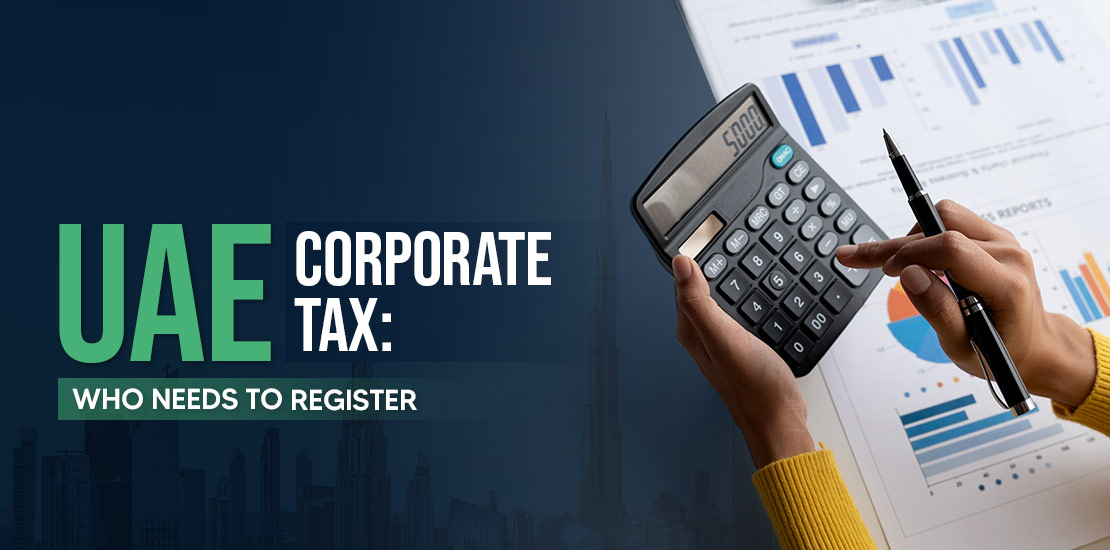
Corporate tax has transformed the business landscape in the UAE, bringing the country in line with global transparency and tax standards. Whether you operate a multinational company, a free zone entity, a small consultancy, or a freelance business, understanding the UAE Corporate Tax Registration rules is essential for staying compliant and protecting your license.
The new tax framework is governed by Federal Decree-Law No. 47 of 2022, and registration is managed through the Federal Tax Authority (FTA) via the EmaraTax digital portal. Once registered, companies receive a Tax Registration Number (TRN) and are required to file an annual return, usually within nine months from the end of the financial year.
Many assume that registration is only required for businesses that actually pay tax. However, under the law, registration is mandatory even if your income is below the taxable limit, or you qualify for exemptions. It proves your compliance, enables access to reliefs, and strengthens trust with banks, partners, investors, and regulators.
Failing to register can result in:
- An AED 10,000 penalty
- Potential licensing restrictions or renewal blocks
- Reputational risk and compliance issues
Who Is Required to Register for Corporate Tax in the UAE?
The Corporate Tax Law defines a wide range of entities that must complete corporate tax registration UAE procedures. Key categories include:
1. Mainland and Free Zone Companies
All incorporated legal entities operating in the UAE must register, regardless of size, revenue, or tax rate. This includes:
- Mainland companies, LLCs, PJSCs, PSCs, and other registered entities
- Free Zone companies, including those eligible for 0% tax on qualifying income
- Holding companies and special purpose vehicles
- Dormant companies that hold an active commercial license
If you possess a UAE trade license, you are required to register. Free zones are not exempt from registration; only the potential tax payment varies.
2. Foreign Companies with Taxable Nexus
Foreign companies must register if they have a taxable presence in the UAE through:
- A Permanent Establishment (PE), such as a branch, office, or fixed site
- Effective place of management in the UAE
- Income derived from real estate or immovable property inside the UAE
Foreign investors should evaluate whether strategic decisions or operations in the UAE trigger the need for registration.
3. Individuals Earning More Than AED 1 million Annually
Corporate tax also applies to natural persons conducting business activities in the UAE. Must register once annual UAE business income exceeds AED 1 million, including:
- Freelancers & consultants
- Influencers and online earners
- Sole proprietorships and traders
- Independent professionals under permits or licenses
Not included: salary income, personal dividends, savings, returns on real estate owned personally.
4. Independent Partnerships
Professional partnerships such as:
- Legal firms
- Accounting & audit firms
- Medical or engineering partnerships
These partnerships are treated as single taxable entities, not as individual partners.
Who Is Exempt from Corporate Tax Registration?
Specific categories are exempt, but may still need to apply for a TRN:
| Exempt Category | Notes |
|---|---|
| Government entities | Fully exempt by law |
| Government-controlled sovereign entities | Exempt for specific activities |
| Approved charities & public benefit organisations | Must apply for recognition |
| Qualifying investment funds | Must meet conditions to maintain exemption |
| Extractive and non-extractive natural resource activities | Taxed under separate regimes |
Note: Some exempt persons must still register to file annual declarations.
Voluntary UAE Corporate Tax Registration
Businesses can voluntarily register before they become liable. Benefits include:
- Enhanced credibility with banks and investors
- Better accounting structure and record keeping
- Easier scaling and compliance readiness
- Ability to claim future exemptions or reliefs
Voluntary registration does not trigger tax payments until thresholds are met.
EmaraTax Pre-Registration
The FTA introduced pre-registration invitations within the EmaraTax portal, encouraging businesses to register before deadlines. If your company did not receive an invitation, you should register manually without delay to avoid penalties.
Documents Required for Corporate Tax Registration
Below are the documents required for corporate tax registration in the UAE:
For Companies
- Trade license copy
- MOA / AOA or partnership agreement
- Passport & Emirates ID for shareholders/directors
- Contact information and registered business address
- Financial year details
- Financial statements (if requested)
For Individuals
- Emirates ID or passport
- Trade license or permit (for business activities)
- Proof of UAE business income
- Contact information and address details
Strategic Benefits of Early Registration
- Banking and investor confidence
- Access to Free Zone relief & Small Business Relief
- Smooth license renewals
- Avoidance of penalties and delays
- Strong compliance reputation
Large Multinationals & OECD Pillar 2 Alignment
For multinational groups with revenues exceeding €750 million (approx. AED 3.15 billion):
- The UAE has implemented the Domestic Minimum Top-Up Tax (DMTT) at 15%
- Applies to financial years beginning 1 January 2025
- Applies to groups with multiple international entities operating across jurisdictions
Multinationals should:
- Review structure and data systems
- Register all constituent entities
- Prepare transition readiness
Expert Guidance With UAE Corporate Tax Registration
Understanding who needs to register for UAE Corporate Tax is the first step; executing it correctly is crucial to avoid penalties and secure compliance confidence.
Shuraa Tax supports SMEs, free zone companies, partnerships, investors, individuals, and multinationals with complete compliance management, including:
- Corporate tax registration UAE
- Corporate tax filing and advisory
- Tax group structuring
- Relief and exemption eligibility assessment
Start your registration with expert support
📞 Call: +(971) 44081900
💬 WhatsApp: +(971) 508912062
📧 Email: info@shuraatax.com
Frequently Aksed Questions
Q1. Do all UAE businesses need to register for corporate tax?
Yes. All companies must register, even if they have no profit.
Q2. Do dormant companies need to register?
Yes, if they still hold a valid trade license.
Q3. Do small businesses below AED 375,000 profit need to register?
Yes. Relief affects tax payable, not registration requirements.
Q4. Are charities required to obtain a TRN?
Most must register first and then apply for exemption.
Q5. Can individuals register voluntarily below AED 1M?
Yes, useful for credibility and growth readiness.
Q7. Does registration mean tax must be paid?
No. Filing is required, but payment depends on thresholds and reliefs.
Q8. What is the penalty for late registration?
AED 10,000.
Q9. What if a business shuts down?
Submit a deregistration request via EmaraTax.